
Money Lending in Afghanistan | Lending & Finance Guide
Explore money lending in Afghanistan, including business, personal, trade and asset-backed financing, lending considerations, risks and financial access.
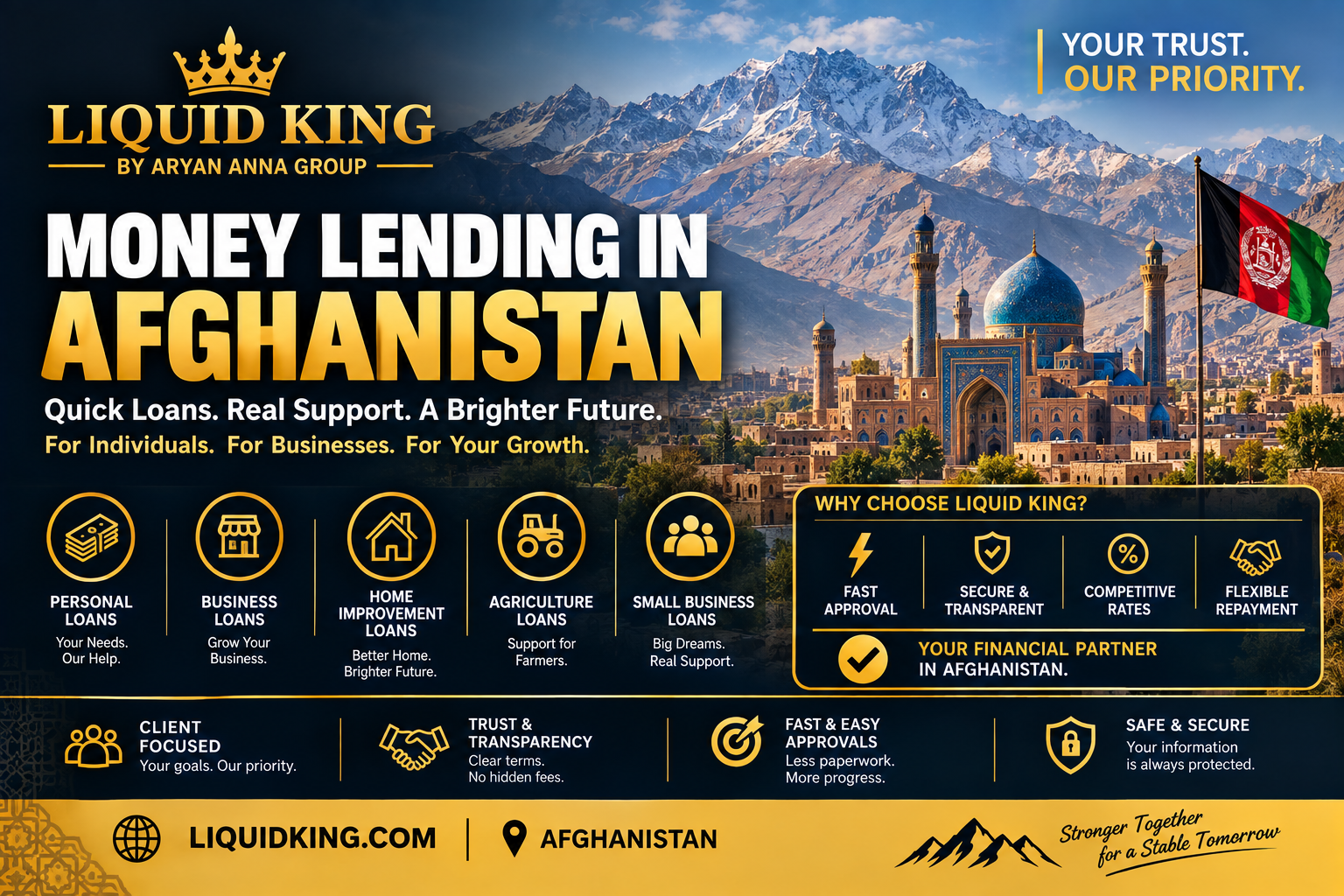
Table of Contents
Money lending in Afghanistan plays an important role in providing individuals, entrepreneurs, traders, and businesses with access to capital. Financing can be used for business operations, trade, agriculture, property-related activities, equipment purchases, and personal financial requirements.
Afghanistan's financial environment differs from many other markets because formal banking access, economic conditions, regulatory requirements, and the availability of financial services can vary considerably. As a result, borrowers may encounter different forms of financing through banks, microfinance institutions, businesses, and other permitted financial channels.
Understanding the available lending structures is particularly important for borrowers who need capital while managing repayment obligations, documentation requirements, currency considerations, and financial risks.
For anyone considering borrowing or providing financing in Afghanistan, careful due diligence and an understanding of applicable laws and financial regulations are essential.
Understanding Money Lending in Afghanistan
Money lending involves providing funds to an individual or organization under agreed repayment conditions. Depending on the financing arrangement, the borrower may repay the principal together with an agreed financing charge or other permissible costs.
Lending arrangements can differ based on:
- Loan amount
- Purpose of financing
- Repayment period
- Borrower's financial position
- Collateral or security
- Business cash flow
- Currency
- Documentation
- Applicable legal requirements
The structure of financing should be clearly documented, and borrowers should understand their obligations before accepting funds.
Types of Lending and Financing
The availability of financing depends on the lender, borrower, purpose, and applicable regulations. Several broad categories can be relevant to the Afghan market.
Business Financing
Businesses may seek financing to purchase inventory, manage working capital, acquire equipment, expand operations, or support trade activities.
Business financing can be particularly important for small and medium-sized enterprises that may have limited internal capital.
Before borrowing, a business should assess expected cash flow, repayment capacity, financing costs, and the expected economic benefit of using the funds.
Trade Financing
Afghanistan's businesses involved in importing, exporting, distribution, and wholesale activities may require financing to support transactions and working capital.
Trade-related financing can help businesses manage the timing difference between purchasing goods, transporting products, selling inventory, and receiving payment.
Agricultural Financing
Agriculture is an important part of Afghanistan's economy, creating potential demand for financing related to farming, livestock, irrigation, equipment, storage, and agricultural inputs.
Agricultural lending can involve additional risks because repayment capacity may depend on harvest conditions, commodity prices, weather, and market access.
Microfinance
Microfinance can provide smaller amounts of financing to individuals and small businesses that may have limited access to conventional banking services.
Microfinance structures should be evaluated carefully, particularly with respect to repayment schedules, total financing costs, eligibility requirements, and borrower protection.
Asset-Backed Financing
Some financing arrangements may involve assets or other forms of security. Depending on the transaction and applicable law, collateral can reduce certain risks for a lender.
Borrowers should understand exactly what assets are being pledged and what may happen if repayment obligations are not met.
How the Lending Process Works
The lending process varies by institution and financing arrangement, but borrowers can generally expect several stages.
1. Identify the Financing Requirement
The borrower first determines the amount required and the purpose for which the funds will be used.
A clear financing purpose can help determine the most appropriate type of lending arrangement.
2. Assess Eligibility
A lender may review information concerning the borrower's income, business activity, assets, existing obligations, repayment capacity, and other relevant factors.
Business borrowers may need to provide financial records and information about their operations.
3. Submit Documentation
Depending on the lender and type of financing, documentation may include identification, proof of income, business records, financial statements, information about collateral, or other supporting documents.
4. Credit and Risk Assessment
The lender evaluates the proposed transaction and assesses the likelihood that the borrower will meet the repayment requirements.
For secured financing, the lender may also evaluate the collateral.
5. Review Financing Terms
Before accepting financing, borrowers should review the amount, repayment schedule, applicable costs, security requirements, default provisions, and other contractual conditions.
6. Disbursement
Once the applicable agreement and requirements have been completed, the financing may be provided according to the agreed structure.
7. Repayment
The borrower then makes payments according to the agreed schedule and maintains appropriate records of the transaction.
Factors That Influence Lending Decisions
Lenders generally consider several factors when evaluating a financing request.
Repayment Capacity
A lender needs to determine whether the borrower has sufficient income or business cash flow to meet the repayment obligations.
Business Performance
For commercial borrowers, revenue, operating performance, financial statements, and business prospects may influence financing decisions.
Collateral
Secured financing may involve property, equipment, inventory, or other eligible assets. The legal enforceability and valuation of collateral should be carefully assessed.
Loan Purpose
The intended use of funds can influence the type and structure of financing available.
Existing Obligations
Existing debts and financial commitments can affect a borrower's ability to take on additional financing.
Currency Risk
Where financing and business revenues are denominated in different currencies, exchange-rate movements can create additional financial risk.
Money Lending for Small Businesses
Small businesses may need financing to purchase inventory, expand operations, acquire equipment, manage seasonal cash flow, or enter new markets.
A business should consider the relationship between borrowed capital and expected business income.
For example, financing inventory may make sense when there is a reasonable expectation that the inventory can be sold within an appropriate period. Borrowing without a realistic repayment plan can create significant pressure on a business's cash flow.
Before taking financing, businesses should review:
- Expected revenue
- Operating expenses
- Existing debt
- Financing costs
- Repayment frequency
- Collateral requirements
- Currency exposure
- Potential changes in market conditions
A basic cash-flow forecast can help businesses determine whether proposed financing is sustainable.
The Role of Banks and Microfinance Institutions
Formal financial institutions can provide structured financing subject to their eligibility requirements and applicable regulatory framework.
Banks may provide financing for individuals and businesses, while microfinance institutions can focus on smaller borrowers and underserved segments.
The services available to borrowers can differ significantly between institutions. Therefore, borrowers should compare the actual terms and requirements rather than assuming that all lenders operate in the same way.
When evaluating a financial institution, borrowers should consider its authorization or regulatory status, documentation requirements, financing terms, customer service, transparency, and repayment procedures.
Digital Finance and Lending
Technology is changing how financial services can be delivered. Digital platforms can support applications, payments, account management, record keeping, and communication between financial institutions and customers.
Potential benefits of digital financial services include:
- Faster application processes
- Electronic record keeping
- Remote access to financial services
- Digital payments
- Improved transaction tracking
- Automated administrative processes
However, digital lending also creates risks. Borrowers should verify the identity and legitimacy of a financial provider before sharing personal or financial information.
They should also carefully review the terms of any digital financing arrangement and avoid making decisions based solely on speed or convenience.
Risks Associated With Borrowing
Borrowing creates a financial obligation and should be approached carefully.
Potential risks include:
- Difficulty meeting repayment obligations
- Variable financing costs
- Currency fluctuations
- Loss of pledged assets
- Business cash-flow pressure
- Additional charges following missed payments
- Legal or contractual disputes
Borrowers should understand the complete cost and conditions of financing before accepting an offer.
It is also important to distinguish between legitimate financial services and informal or potentially unlawful lending arrangements. Unclear contracts, excessive pressure, undisclosed costs, or requests for unusual upfront payments should be treated cautiously.
Regulatory and Legal Considerations
Financial services in Afghanistan operate within a regulatory environment overseen by the country's relevant financial authorities. The Da Afghanistan Bank is the central bank and has responsibilities relating to banking and financial-sector regulation.
Lending activities can be subject to different requirements depending on the institution, type of financing, borrower, and transaction.
Because financial regulations and operating conditions can change, businesses and individuals should verify current requirements before entering into significant lending transactions.
For larger commercial, property, or cross-border transactions, appropriate legal and financial advice can be particularly important.
How to Choose a Money Lending Service in Afghanistan
Choosing a lender requires careful evaluation of the complete financing arrangement.
Verify the Provider
Borrowers should confirm that the institution or provider is authorized to conduct the relevant financial activity where applicable.
Understand the Full Cost
Do not evaluate financing solely on the advertised rate or headline terms. Review all applicable charges and expenses.
Examine Repayment Conditions
Understand when payments are due, how they are calculated, and what happens if a payment is delayed.
Review Collateral Requirements
If assets are pledged, borrowers should understand the legal documentation and consequences associated with default.
Check Currency Terms
If financing involves foreign currency, borrowers should consider the potential impact of exchange-rate movements.
Read the Agreement
Important provisions concerning default, fees, security, early repayment, and dispute resolution should be understood before signing.
Responsible Borrowing
Responsible borrowing begins with determining whether the financing is necessary and whether repayment is realistically affordable.
Borrowers should:
- Establish a clear purpose for the funds
- Borrow only what is reasonably required
- Prepare a repayment plan
- Maintain financial records
- Compare available financing options
- Understand all applicable costs
- Keep copies of agreements and payment records
- Seek professional advice for complex transactions
Businesses should also consider how borrowing will affect working capital and future cash flow.
Future of Money Lending in Afghanistan
The future development of money lending in Afghanistan will depend on several factors, including economic conditions, financial-sector development, regulatory policies, access to formal financial services, technology, and the broader business environment.
Digital financial services may create opportunities to improve access to payments and other financial products. Greater use of financial technology could also support more efficient record keeping and service delivery.
At the same time, responsible lending, transparency, financial stability, consumer protection, and appropriate regulatory oversight remain important for the sustainable development of the lending sector.
Conclusion
Money lending in Afghanistan encompasses financing options that can support individuals, entrepreneurs, agricultural activities, traders, and businesses. Depending on the circumstances, borrowers may encounter business financing, trade-related financing, agricultural lending, microfinance, and asset-backed arrangements.
Choosing appropriate financing requires careful consideration of repayment capacity, financing costs, collateral, currency exposure, contractual conditions, and the credibility of the financial provider.
Borrowers should conduct appropriate due diligence and verify current legal and regulatory requirements before entering into a significant financial agreement. A well-structured financing arrangement should provide useful access to capital while keeping repayment obligations realistic and transparent.
Important Disclaimer: This article is provided for general educational and informational purposes and does not constitute financial, legal, tax, or investment advice. Lending availability, financing terms, regulatory requirements, interest or other financing charges, and eligibility conditions can vary by institution and transaction. Readers should verify current Afghan laws and regulatory requirements and conduct appropriate due diligence before entering into a lending arrangement. Complex commercial, property, or cross-border transactions should be reviewed with appropriately qualified professional advisers.