
Money Lending in Florida | Lending Options & Guide
Explore money lending in Florida, including personal, business, real estate, and private lending options, the lending process, risks, and key considerations.
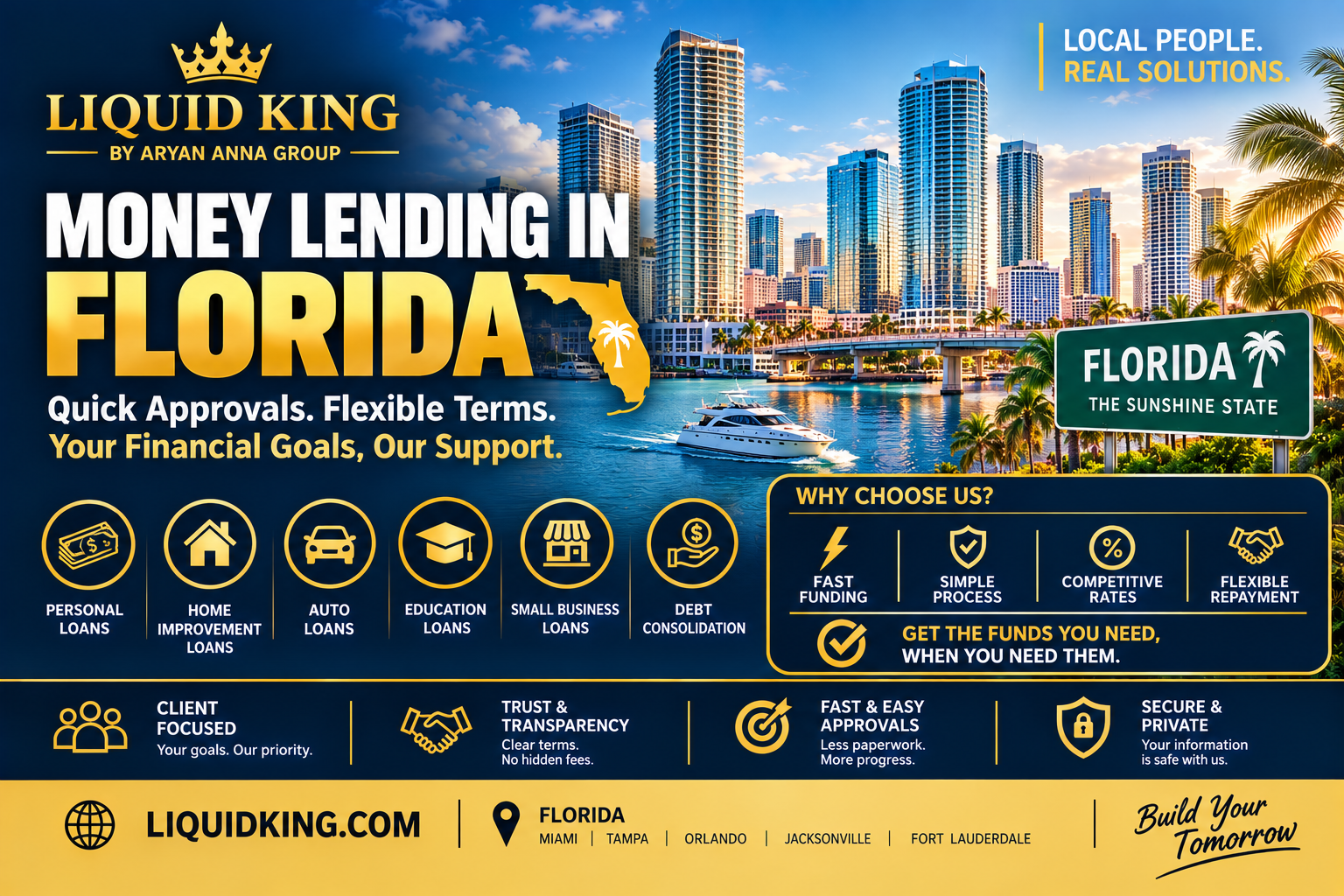
Table of Contents
Money lending in Florida provides individuals, entrepreneurs, businesses, property investors, and other borrowers with access to capital for a wide range of financial needs. Lending can support personal expenses, business expansion, real estate transactions, working capital, equipment purchases, and other legitimate financial requirements.
Florida has a diverse economy supported by industries including real estate, tourism, healthcare, technology, construction, professional services, logistics, and small businesses. This broad economic activity creates demand for different forms of financing, ranging from conventional loans offered by financial institutions to specialized lending arrangements.
Understanding the different types of lenders, loan structures, eligibility requirements, costs, and risks can help borrowers make more informed decisions. Lending terms can vary significantly depending on the borrower, purpose of financing, collateral, credit profile, loan amount, and applicable regulations.
Understanding Money Lending in Florida
Money lending refers to providing capital to an individual, business, or other borrower with an agreement that the funds will be repaid according to specified terms. Depending on the lending arrangement, repayment may include interest, fees, or other agreed charges.
Common lending considerations include:
- Loan amount
- Interest rate
- Repayment period
- Monthly or periodic payments
- Collateral requirements
- Creditworthiness
- Origination or administrative fees
- Prepayment terms
- Default provisions
- Applicable legal and regulatory requirements
The structure of a loan should be clearly understood before a borrower accepts financing.
Types of Money Lending Available in Florida
Borrowers may encounter several different types of lending depending on their financial requirements.
Personal Lending
Personal loans may be used for eligible personal expenses such as major purchases, debt consolidation, home improvements, education-related expenses, or unexpected costs.
Eligibility and loan terms can depend on factors such as credit history, income, existing obligations, and the lender's underwriting requirements.
Business Lending
Business financing can help companies fund working capital, expansion, equipment, inventory, technology, or other operating requirements.
Business lending may include:
- Business term loans
- Working-capital financing
- Equipment financing
- Commercial lines of credit
- Business expansion loans
- Asset-backed financing
Businesses should evaluate the expected cost of borrowing against the potential financial benefit of the investment.
Real Estate Lending
Florida's active property market creates demand for real estate financing. Borrowers may seek financing for residential, commercial, investment, construction, or property-development purposes.
Real estate loans may be secured against the property, depending on the structure of the transaction.
Private Lending
Private lending generally involves financing provided outside traditional bank lending channels. Private lenders may evaluate the borrower's financial position, project, collateral, repayment plan, and other factors.
Private lending can sometimes provide more customized structures, but borrowers should carefully review interest rates, fees, collateral requirements, and repayment conditions.
Commercial Lending
Commercial lending is designed primarily for businesses and larger financial transactions. It may support acquisitions, expansion, commercial property purchases, equipment, development projects, and other business activities.
The underwriting process for commercial financing can involve detailed financial statements, business plans, cash-flow analysis, collateral evaluation, and other documentation.
How the Lending Process Works
Although lending procedures differ between lenders, a typical borrowing process follows several stages.
1. Determine the Financing Requirement
The first step is identifying how much capital is required and why it is needed.
Borrowers should avoid borrowing more than necessary and should establish a realistic repayment plan.
2. Review Eligibility
Lenders may evaluate:
- Credit history
- Income
- Employment or business activity
- Existing debt
- Cash flow
- Assets
- Collateral
- Loan purpose
Business borrowers may also need to provide financial statements, tax information, business plans, and other documentation.
3. Submit an Application
The borrower provides information and supporting documents required by the lender.
The lender then reviews the application according to its underwriting standards.
4. Loan Evaluation
The lender assesses the borrower's ability to repay the financing and evaluates relevant risks.
For secured lending, the lender may also assess the value and legal status of the collateral.
5. Review the Loan Offer
If approved, the borrower should carefully review the proposed interest rate, fees, repayment schedule, collateral requirements, penalties, and other terms.
6. Closing and Funding
After the applicable documentation is completed, the loan may be finalized and funds provided according to the agreed arrangement.
7. Repayment
The borrower makes payments according to the loan agreement. Maintaining timely payments can help avoid additional costs and potential damage to credit standing.
Factors That Can Affect Lending Terms
Not every borrower receives the same loan terms. Lenders generally evaluate several factors when determining whether and how to provide financing.
Credit Profile
Credit history can influence both eligibility and the cost of borrowing.
Income and Cash Flow
Lenders may assess whether the borrower has sufficient income or business cash flow to meet repayment obligations.
Loan Amount
Larger loans may involve more extensive underwriting and, depending on the transaction, collateral or additional documentation.
Collateral
Secured loans may require assets to be pledged as collateral. If the borrower fails to meet the agreement, the lender may have rights over the collateral subject to applicable law.
Loan Purpose
The intended use of funds can influence the type of financing available and the lender's evaluation process.
Repayment Period
Longer repayment periods can reduce periodic payments but may increase the total amount of interest paid over the life of the loan.
Money Lending for Florida Businesses
Small and medium-sized businesses may require financing at different stages of their development. A company might seek funding for inventory, payroll, equipment, marketing, expansion, technology, or property.
Business borrowers should consider whether the expected return from using borrowed capital justifies the cost and repayment obligation.
For example, financing equipment that increases productive capacity may have a different financial rationale from borrowing to cover recurring operating losses.
Before taking business financing, companies should review:
- Expected cash flow
- Total borrowing costs
- Existing debt
- Repayment schedule
- Business revenue stability
- Collateral requirements
- Potential impact on working capital
A clear financial plan can help businesses use borrowed funds more effectively.
Real Estate and Property Lending in Florida
Real estate financing represents an important area of the Florida lending market. Property investors, developers, homeowners, and businesses may seek financing for different types of transactions.
Depending on the transaction, real estate financing may include:
- Property acquisition loans
- Construction financing
- Commercial real estate loans
- Investment property financing
- Bridge financing
- Development financing
Borrowers should understand the relationship between the loan amount, property value, expected income, interest costs, and repayment schedule.
Real estate transactions can also involve significant legal and financial complexity. Appropriate professional due diligence is particularly important for larger or specialized transactions.
Choosing a Money Lender in Florida
Selecting a lender should involve more than comparing advertised interest rates. Borrowers should evaluate the complete financing arrangement.
Compare the Total Cost
Look beyond the headline interest rate. Consider origination fees, administrative charges, closing costs, late fees, and other applicable expenses.
Understand Repayment Terms
Review the payment frequency, loan maturity, amortization schedule, and conditions associated with early repayment.
Check Applicable Licensing and Registration
Depending on the type of lending activity, different federal and Florida regulatory requirements may apply. Borrowers should verify that the lender and lending arrangement comply with applicable requirements.
Review the Contract Carefully
Loan agreements can contain important provisions concerning collateral, default, late payments, acceleration, fees, and dispute resolution.
Assess the Lender's Transparency
A professional lender should clearly communicate the loan structure, costs, requirements, and repayment obligations.
Avoid Pressure-Based Decisions
Borrowers should have sufficient time to understand financing terms before committing to a significant financial obligation.
Technology and Digital Lending
Technology has changed how borrowers apply for and manage financing. Digital platforms can streamline application processes, document collection, identity verification, underwriting, and loan servicing.
Modern lending technology may include:
- Online loan applications
- Automated document processing
- Digital underwriting
- Electronic signatures
- Automated payment systems
- Online account management
- Data-driven credit assessment
Digital lending can make financing more accessible and efficient, but borrowers should still verify the identity and legitimacy of a lender and carefully review all terms before providing financial information or accepting a loan.
Risks and Responsibilities of Borrowing
Borrowing money creates a financial obligation. Regardless of the type of loan, borrowers should understand the risks associated with taking on debt.
Potential risks include:
- Difficulty meeting repayment obligations
- Interest-rate changes on variable-rate loans
- Additional fees
- Collateral loss in secured transactions
- Credit consequences following missed payments
- Increased financial pressure
- Cash-flow constraints
Borrowers should develop a realistic repayment plan before accepting financing.
A loan should generally be evaluated based on its total cost and expected financial benefit rather than simply the amount of money that becomes available.
Regulatory Considerations for Money Lending in Florida
Money lending is subject to legal and regulatory requirements that can vary according to the type of lender, borrower, loan, and transaction.
Florida has state-level financial regulatory authorities, while certain lending activities are also subject to federal laws and regulations. Consumer lending, mortgage lending, commercial financing, and other specialized activities may have different requirements.
Because regulations can change and may depend on the specific transaction, borrowers and lenders should obtain appropriate legal or regulatory guidance when necessary.
Borrowers should also be cautious of lenders that make unclear promises, request unusual upfront payments, conceal loan costs, or fail to provide understandable documentation.
Future of Money Lending in Florida
The lending industry is continuing to evolve through digital platforms, automated underwriting, data analytics, electronic documentation, and new approaches to borrower evaluation.
Technology may make lending processes faster and more convenient, while regulatory oversight and responsible lending practices remain important.
Businesses and individuals may also increasingly seek financing that is tailored to specific requirements rather than relying on a single traditional lending model.
Despite these changes, fundamental lending principles remain important: borrowers need to understand the cost of capital, lenders need to evaluate repayment risk, and both parties should operate within applicable legal and regulatory frameworks.
Conclusion
Money lending in Florida encompasses a broad range of financing options for individuals, businesses, property investors, and other borrowers. Personal loans, business financing, real estate lending, private lending, and commercial financing can serve different financial requirements.
Choosing appropriate financing requires careful consideration of interest rates, fees, repayment schedules, collateral, eligibility requirements, and the total cost of borrowing. Borrowers should also verify relevant regulatory information and conduct appropriate due diligence before entering into a lending agreement.
Responsible borrowing begins with understanding both the opportunity and the obligation created by debt. By evaluating financing carefully and maintaining a realistic repayment plan, borrowers can make more informed decisions about how lending fits into their broader financial objectives.
Important Disclaimer: This article is provided for general educational and informational purposes and does not constitute financial, legal, tax, or investment advice. Lending terms, eligibility requirements, fees, interest rates, licensing requirements, and applicable regulations vary by lender and transaction. Borrowers should conduct appropriate due diligence, carefully review loan documentation, and consult qualified professionals where appropriate. Taking on debt involves financial risk, and borrowers should ensure that repayment obligations are consistent with their financial circumstances.